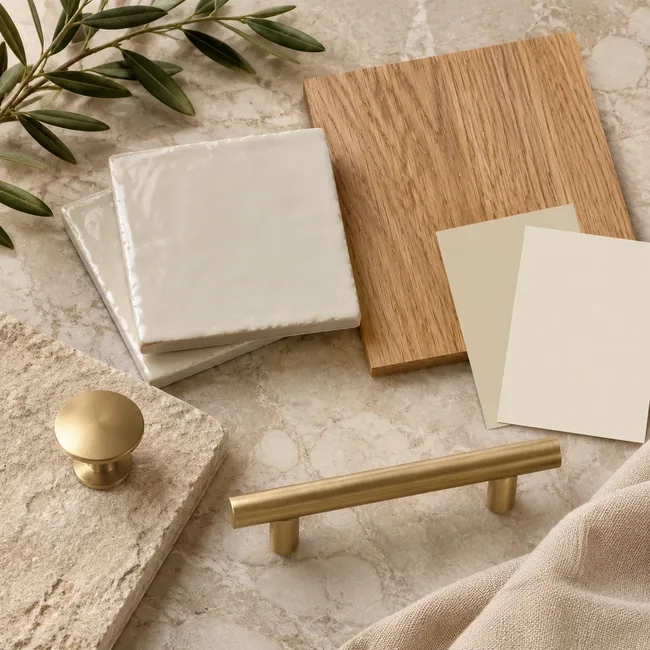
A 2-inch tile strip is a narrow band of tile—usually mesh-mounted mosaic pieces or a single cut strip—roughly 2 inches wide, used to cap edges, form borders, transition between surfaces, or fill tight gaps.
No — blue is not a masonry designation. A blue screw can be a masonry anchor, a coated deck screw, a drywall screw with a blue phosphate finish, a pocket-hole screw, or a roofing screw, depending on who coated it and why.
Laminate flooring sold at Home Depot is generally safe for typical residential use when it's installed as intended and the product's indoor-air and slip ratings are checked before purchase.
Ball bearing hinges are better for most swinging doors in daily use because they reduce friction at the pivot, carry heavier loads with less effort, and hold up longer than plain washers under repeated cycling.
Drywall lifts are not only for ceilings, but ceiling work is what they do best. A standard panel hoist is built around an overhead lifting action, so it handles horizontal ceiling sheets far more comfortably than vertical wall sheets.
A dented spray paint can is safe to use only when the dent is shallow, sits away from the seams and the valve, and hasn't distorted the can's shape or caused leakage.
The string describes a wall or floor tile whose nominal face is about 5-7/8 by 7-7/8 inches (roughly 150 × 200 mm) , in a 165 HS01 style/color number—not a 165-inch tile.
Yes, loose branches resting on or hanging from overhead wires are dangerous, primarily because they create an electrical path between a conductor and the ground, a person, or a structure.
No, standard drywall screws are not rust proof. The typical black phosphate-coated screw used for hanging gypsum board has only a thin conversion coating that resists light handling and minor humidity, not sustained moisture, and it will…
Door knobs are interchangeable only within matching hardware standards—mainly the bore size, backset, and latch/faceplate dimensions—not as a universal swap.
Costco's vinyl and laminate flooring is generally good value for the money, but the right answer depends on which of its two very different product types you're considering.
Paint edgers are good enough to replace brush-cut-in work on many straightforward walls, especially for homeowners who struggle to keep a steady line along ceilings, baseboards, and trim.
Paint edgers are worth it for a specific, fairly common job: cutting a clean line where a wall meets a ceiling, trim, or another wall color when you don't trust your brush hand.
No, not all laminate floors are floating. The overwhelming majority of residential laminate products are installed as floating floors, but glue-down laminate installation exists, and some laminate can be fastened or adhered over specific…
Horizontal drywall cracks are bad when they run along a seam that is visibly separating, when the wall on one side sits lower or further out than the other, or when the crack keeps reopening after repair.
Insulation baffles are necessary wherever a vented roof assembly depends on a clear path for air to travel from the soffit intakes at the eaves up into the attic and out through ridge or gable vents.
Most natural insulation materials are non-toxic in the sense that matters to a homeowner: they aren't made from petrochemical foams or formaldehyde binders, and they don't off-gas in a closed wall.
Dollar Tree paint brushes are good for disposable job-site tasks—applying polyurethane to a small repair, daubing stain on a fence picket, priming a patch of drywall, or letting a child paint a craft—but they're a poor choice for finish…
Aluminum sliding doors win on strength, slim sightlines, and large panels, while vinyl (PVC) sliding doors win on thermal performance and lower upfront cost in typical residential sizes.
Laminate floors can be slippery, but the surface itself isn't unusually slick compared with other hard flooring—grip depends far more on finish texture, moisture, dust, and what you're wearing.
Yes, drywall nail pops are normal in the sense that they're a common, well-understood behavior of wood-framed drywall construction, not a sign of defective drywall or a failing house.
Anchors aren't always necessary, but they become necessary whenever a structure must resist uplift, sliding or overturning forces that its own weight cannot safely handle.
Merlot is a color, not a construction method, so a merlot cabinet can be either laminate or veneer—and often it's neither, but a painted or stained wood or MDF door.
Bio-based pavement sealants are not automatically biodegradable, and most cured sealant films break down very slowly, if at all, under normal pavement conditions.
Drywall screws do not have to screw into a wall stud when the goal is simply to fasten drywall to a solid backing such as another layer of drywall, plywood, or a wood furring strip.
A doorknob set is not handed in the way a lever set is. Most common round-knob sets and the standard cylindrical locksets behind them are reversible or symmetrical, so one box can serve a left- or right-swinging door.
A manufactured home secured to a permanent foundation is generally as safe as a site-built house of comparable construction, provided the foundation and anchoring meet the applicable code and the home is installed correctly.
Metal studs can be a sound structural choice for parts of an outdoor kitchen, but only when the steel is kept dry or is genuinely rated for wet, coastal, or load-bearing exposure.
No. Oakridge and Wooddrift are two separate shingle product lines from the same manufacturer, Owens Corning, and they are built differently: **Oakridge shingles are laminated (architectural) shingles, while Wooddrift shingles are a…
No, most finished home floors are not just plywood. In new construction the plywood or oriented strand board (OSB) you see during framing is a structural subfloor, and a finished floor covering—hardwood, engineered wood, laminate, vinyl,…